Friday, May 29, 2026

Kitchen Table Literacy?

Not everyone likes pound cake.

That truth feels simple, almost obvious—but it carries a lesson we too often ignore in classrooms, communities, and conversations about literacy.

There are many flavors. Many textures. Many preferences. Some crave sweetness. Others want something lighter, less dense. Some don’t want dessert at all. And none of those responses are wrong.

Yet we live in a world that often treats difference as deficiency.

In literacy spaces especially, students are taught—sometimes subtly, sometimes explicitly—that there is a right way to read, a right way to respond, a right way to argue. But real literacy—the kind that liberates—teaches us something else entirely: perspective is shaped, not standardized.

The beauty of pound cake is not only in how it tastes, but in how it’s made.

The slow mixing.
The careful sifting.
The squeezing of butter until it softens just right.
The familiar burn of a Bundt pan that’s seen generations.
The patience of letting the cake rest before cutting into it.

That process matters.

In literacy, the same is true. Students arrive carrying histories, cultures, wounds, and wisdom that shape how they interpret texts and construct meaning. When we rush them toward a single “correct” interpretation, we rob them of the very process that makes learning human.

Not everyone is called to bake.
Not everyone is drawn to sweet things.

But all of us carry a kitchen-table memory—a moment where care was practiced, where presence mattered, where something was prepared with intention. That memory becomes the lens through which we read the world.

When literacy honors those lenses, classrooms become places of belonging rather than compliance. Argument becomes dialogue rather than debate. Difference becomes something to study—not something to fix.

As educators, coaches, and leaders, our work is not to decide which cake is best.
Our work is to teach students how to:

  • Notice ingredients
  • Respect process
  • Name preference without dismissing others

That is how literacy becomes an act of care.

And that is how learning becomes something worth savoring.


When Words Become Bread: A Gospel of Healing, Literacy, and Survival

There are moments in life when survival does not come through medicine, certainty, or even answers—but through presence. Through being seen. Through nourishment that looks ordinary on the surface but is sacred at its core.

Reading Salaam Green’s reflection, “The Gospel of Pound Cake” , stirred something deep in me. Her meditation on baking—on feeding others with intention, tradition, and care—reminded me that healing often arrives disguised as ritual. As something passed hand to hand. As something made slowly, lovingly, and without spectacle.

Book I: The Gospel According to Words

For me, that nourishment came through words.

I will never forget how writing with Salaam through the Forge Young Survivors support group became a revival experience—an awakening during a season when my body was betraying me and I genuinely feared I might lose my mind. Chronic illness has a way of isolating you. Of making your pain invisible. Of inviting doubt—from others and eventually from yourself.

When others doubted my struggle, story believed me.

In that space, Salaam reminded us—again and again—of the power of pen and story. She treated words like bread. Like sustenance. Like something holy enough to hold grief, rage, joy, and hope all at once.

Book II: Thrivors at the Table

Writing became the kitchen table where I could sit without explanation. Where my body could be weak, but my voice could still be strong. Where testimony didn’t need to be polished to be valid.

Through that sacred space, I—and so many other thrivors—found joy in the journey toward healing, even when healing itself felt unfinished.

That is what The Gospel of Pound Cake names so beautifully: that care does not always arrive loudly. That nourishment is often repetitive and humble. That love looks like showing up, again and again, with what you know how to make.

Sometimes healing doesn’t announce itself.
It shows up warm, familiar, and shared.

There are many flavors to pound cake—and that, too, is part of the gospel.

Not everyone likes pound cake. Some savor the sweetness. Others notice the density, the crumb, the crust that forms just right around the edges. And some simply don’t care for it at all. But the gift is not only in the tasting—it’s in the process.

The slow mixing. The careful sifting. The squeezing of butter until it softens just right. The familiar burn of a well-worn Bundt pan. The patience of resting before release.

Not everyone is called to bake. Not everyone is drawn to sweet things. But all of us carry a kitchen-table memory—a place where care was practiced, where presence mattered, where something was prepared with intention.

That is where perspective lives. That is where difference is honored. And that, too, is where story begins.

Book III: Literacy as Medicine

As a literacy educator, coach, and advocate, I have long believed that literacy is liberation. But experiences like these remind me that literacy is also medicine. It is survival. It is community. It is care.

When we invite people to write their stories—especially those whose bodies, identities, or histories have been questioned—we are not just teaching writing. We are offering nourishment. We are saying:

  • You deserve to be fed.
  • You deserve to be heard.
  • You deserve to live.

In my classroom, in my coaching, and in my own healing, I return to this truth often:

Words create space.
Stories create community.
And sometimes, writing is the pound cake—
keeping us alive.

Called. Lit. Leading.

This is why I remain called to teach.
This is why I stay lit to lead.

Because when words are treated as sacred, they become sustenance for the soul.

And that, too, is gospel.

Reflection for the Reader

I invite you to sit with these questions and share in the comments:

  1. Who or what has nourished you during a season of survival?
  2. Where have words—writing, storytelling, testimony—created space for your healing?
  3. What everyday practice in your life feels sacred, even if it looks ordinary?

May we continue to feed one another—through story, through presence, through care.

Sunday, January 25, 2026

Called to Be a Bridge, Positioned for What’s Next

After twenty years in K-12 education—and now serving as a college instructor- I find myself standing at the edge of something new. I am not standing still; I am positioned, prepared, and miles ahead of where I once was.

It’s funny how God has a way of reminding us of the prayers we whispered years ago—the ones we almost forgot we asked. For as long as I can remember, my heart’s desire has been simple and steady: to serve as a bridge.

Miles Ahead: Purpose Before Platform

Technology has transformed how we teach, and in my current role I see that transformation unfolding in real time. Digital tools, AI, and multimodal platforms are expanding access and opportunity.

“Technology may transform the how, but purpose sustains the why—and that’s what keeps us miles ahead.”

Let’s Talk — Because Education Is Always Evolving

Join the conversation in the comments:

  • What does intentional teaching look like in your current season?
  • How has technology changed your practice?
  • What keeps you grounded in your why?
  • Where are you called to be a bridge?

Teaching—when rooted in intention and guided by faith—will always be more than a job. It’s a calling.

Planting Seeds

Growing up, I often heard a simple phrase spoken with deep intention: “Presentation is key.”

In my childhood home, it meant more than how something looked. It meant care. Respect. Honor for the people you were serving.

Years later, as an educator, I’ve come to understand that teaching carries that same responsibility.

Because every day in our classrooms, we’re not just delivering lessons.

          We’re planting seeds.


What We Plant Matters

Teaching to change the world begins with recognizing that every interaction, every decision, and every belief we carry becomes a seed in the lives of our scholars.

Some seeds are planted intentionally — through carefully designed lessons, culturally responsive practices, and spaces built on trust and belonging.

Others are planted quietly — through our tone, our expectations, our silence, and the assumptions we fail to examine.

Over time, those seeds take root.

They shape how scholars see themselves.
How they understand their worth.
How they imagine their future.

“Every interaction becomes a seed in the life of a scholar.”

I learned early that I carry tremendous power into every learning space.

I can reinforce systems that sort and silence-or I can interrupt them. 

Presentation Is Key — But So Is Perception

In education, “presentation” often takes on a different meaning.

It becomes a measure of who looks prepared.
Who sounds “right.”
Who fits the unspoken mold of what success should look like.

Too often, scholars are judged not by the depth of their thinking, but by the surface of their performance.

I have taught scholars whose brilliance was hidden behind dialect.
Whose intelligence was overlooked because of posture, clothing, or quietness.
Whose gifts went unseen because their presentation did not align with dominant norms.

“Too often, we judge the surface before we ever see the soil.”

Teaching to change the world requires us to ask difficult questions:

  • Whose seeds am I watering?
  • Whose growth am I overlooking?
  • Whose brilliance might be hidden behind the weeds, my assumptions?

Because if we only nurture what already looks polished, we miss the most transformative possibilities.

Honoring the Soil Our Scholars Come From

Seeds don’t grow the same in every kind of soil.

And neither do scholars.

Context matters.
Culture matters.
History matters.
Identity matters.

I’ve watched families chase opportunity across district lines only to discover inequity had followed them.

I’ve seen how policies, access, and resources shape which scholars receive sunlight and which are left struggling in the shadows.

That is why culturally responsive, student-centered teaching is not an “add-on” for me — it is the foundation I stand on.

It is how I honor scholars’ hidden literacies.
It is how I restore joy.
It is how I interrupt practices that harm.

“We don’t just teach content — we cultivate conditions.”


Becoming a Gardener of Possibility

Before I teach an ounce of content, begin a coaching cycle, facilitate a PLC, or design professional learning, I prioritize building a climate and culture where people feel safe enough to grow.

Before I analyze data, I listen to stories.
Before I demand excellence, I establish care.

Because growth does not happen where fear lives.

Teaching in this generation is complex.

We are navigating AI, algorithms, social media, shifting policies, and systems that often resist change.

And yet — our scholars still need us.

They need us to be gardeners of possibility — educators who understand that transformation does not happen overnight, but through faithful, intentional planting.

“Transformation does not happen overnight. It grows.”


What Will Grow After Us

When I think about teaching to change the world, I no longer imagine grand gestures or perfect lessons.

I imagine seeds.

Seeds of confidence.
Seeds of critical consciousness.
Seeds of joy.
Seeds of justice.

My teaching is shaped by my story.
Seasoned by my faith.
Strengthened by my scars.
And sustained by my scholars.

And every day, I return to the classroom with the same quiet prayer:

Let what I plant today grow into something that makes the world better tomorrow.

Because somewhere, a scholar is waiting to discover their brilliance.

And somewhere, a classroom is becoming a garden where liberation begins —
one seed,
one lesson,
one teacher at a time.


Reflection Questions (Join the Conversation)

  1. What “seed” did a teacher plant in you that still shows up in your life today?
  2. When you hear “presentation is key,” what comes up for you in school spaces — affirmation, pressure, both?
  3. What is one way we can better recognize brilliance that doesn’t come packaged the “expected” way?

If this post resonated with you, share it with an educator who is doing the quiet work of planting seeds — especially on the days when growth feels slow.

— Shonterrius Lawson-Fountain
Called to teach. Lit to lead.


Thursday, December 18, 2025

Curious, Committed, Certified: Unpacking My Journey at the 2025 Ditch That Textbook PD Summit

Every once in a while, professional learning shows up not as another “thing to do,” but as an invitation—to rethink, reimagine, and reignite our practice.

That’s exactly why I’m leaning into this year’s Ditch That Textbook Digital Summit.

“I’m not ditching the work—I’m deepening it. Four+ certificates in and counting.”

What I love most is the how: this is free, high-quality, on-demand professional learning designed for real educators with real lives. Sessions are released daily, available for rewatching, and grounded in what actually moves teaching and learning forward— technology with purpose, pedagogy with heart, and strategies you can use tomorrow.

And let’s talk about flexibility: sessions are pre-recorded, so you can engage when it works for you—during a planning period, a quiet evening, or a reflective weekend moment. No pressure. No performative PD. Just space to grow.

Even better? You can earn free PD certificates simply by engaging and reflecting.

And listen—I have four+ certificates already and I’m counting! I challenge you to chime in on the fun and join me. We’re better when we learn together. 💛

Register for Free Tip: bookmark it so you can pop in daily.

Tech 20 Time- Free AI PD (Padlet)


Made with Padlet

Tuesday, July 22, 2025

Beyond the Buzz: Reclaiming AI for Real Classrooms

When I first heard the buzz about AI in education, I admit—I was skeptical. Not because I feared the tools, but because I feared how they might be used to further widen gaps between access and equity, purpose and product. But Matt Miller’s AI for Educators (2023) challenged me to look again. It isn’t about replacing teachers—it’s about restoring their capacity to do what matters most: connect, create, and care.

In fact, this call to reimagine learning aligns directly with what I uncovered in my action research study, Lyrics & Lines: Exploring How Pop Culture, Music, and Social Commentary Influence Teacher Perspectives and Instructional Practices (Lawson-Fountain, 2025). That work explored how multimodal texts—especially music and social commentary—can enhance student voice, engagement, and critical literacy. Embracing AI tools doesn’t mean abandoning that mission. It means amplifying it.

Before the book, there was the blog. Miller’s award-winning Ditch That Textbook has long been a beacon for educators like me—those who are committed to innovating instruction without abandoning authenticity. His blog inspired the heart behind this book, and that heart beats for one thing: making teaching work for real classrooms.

AI as a Co-Teacher, Not a Replacement

Miller (2023) reminds us that AI should never replace the human elements of teaching—it should support them. He writes, “Let AI handle the grunt work. Let us do the heart work” (p. 89). This resonated deeply with both my instructional coaching practice and the findings from Lyrics & Lines. During the study, teachers reclaimed joy and relevance when they leaned into multimodal texts like music, poetry, and pop culture. With the right approach, AI tools like MagicSchool or Diffit can amplify those same experiences—extending access, deepening differentiation, and re-centering engagement (Lawson-Fountain, 2025).

I’ve worked alongside teachers who used AI to streamline lesson planning and feedback, freeing up time and cognitive load to focus on culturally responsive instruction. One even used ChatGPT to remix song lyrics into student-friendly prompts, bridging curriculum with identity and relevance.

From Digital Trickery to Digital Transformation

There’s a big difference between tech integration that dazzles and tech that delivers. Miller (2023) warns against “digital trickery”—flashy tools with no depth—and instead urges educators to pursue meaningful transformation. That happens when tools align with student identity, agency, and voice.

In Lyrics & Lines, teachers found that pairing lyrics with historical texts or media clips sparked conversations that traditional textbooks couldn’t touch (Lawson-Fountain, 2025). Now, with the thoughtful integration of AI, that work can go even further. I’ve helped colleagues use Canva’s Magic Write and other AI platforms to co-create graphic organizers, formative assessments, and quote cards that support multimodal literacy while honoring cultural relevance. The goal? To deepen—not dilute—student thinking.

🎯 Try it: Use Magic Write or ChatGPT to generate three essential questions from a song lyric related to your current unit. Let students respond through Flip, a meme, or a mini podcast.

When we design for engagement—not compliance—students show up differently.

The Ethics of Empowerment

It’s not enough to use AI. We must use it critically. That includes asking who created the dataset, whose voices are missing, and how our students are taught to engage with digital tools as readers, writers, and thinkers. Amerstorfer and Freiin Von Münster-Kistner (2021) stress the importance of student-teacher relationships and emotional engagement, which AI can never replicate but can support through strategic use.

Lyrics & Lines revealed what I already knew in my bones: culturally responsive instruction is a matter of justice. When we help students see themselves in texts—whether it’s through Nas, Nikki Giovanni, or neural networks—we affirm that their stories matter. AI can help us get there faster. But only if we bring our full selves—our discernment, ethics, and empathy—to the table (Lawson-Fountain, 2025).

Where AI Meets Activism

As educators, we often stand at the crossroads of innovation and tradition. The temptation is to automate. But the invitation is to innovate—with purpose.

Miller’s framework helped me reimagine what’s possible. So did seeing the shift in teacher practice through my study. When given space, support, and tools, teachers didn’t just “try AI”—they transformed how students experienced writing, reading, and argumentation (Lawson-Fountain, 2025).

As one teacher reflected: “Using song lyrics in my classroom gave my students access points to skills they used to avoid. AI gave me time to lean in and respond differently.”

Want to Learn More About Multimodal Instruction?

Explore the graphic below created using Canva + AI Magic Design, illustrating how AI supports multimodal learning grounded in culturally responsive practices. As Razgatlıoğlu and Ulusoy (2022) noted, poetic and artistic texts provide natural opportunities for creativity and fluency in ways traditional instruction often overlooks.

Figure 1. Multimodal Learning in Action: A Blend of Lyrics, AI, and Literacy. Illustration designed using AI to reflect the integration of AI tools (MagicSchool, Canva, ChatGPT) with culturally responsive instruction.


Final Thoughts: Tomorrow's Glasses

I’ve come to believe AI isn’t the enemy of education—it’s the invitation. But it demands courage. Courage to reimagine what writing, thinking, and teaching can look like. Courage to challenge inequity by ensuring all students—not just the tech-privileged—get to use tools that prepare them for the world they’re inheriting.

We have to put on tomorrow’s glasses. AI is here to stay. Rather than dismiss or fear it, we must embrace the possibilities it offers us as educational practitioners—to create dynamic classrooms that cultivate emerging leaders. Our students will be competing with AI for jobs. The workforce they’re heading into will demand a high level of digital literacy, creativity, and application. That work starts with us.

So here’s your call to action:

  • 🎤 Try one AI tool this week—not to replace your expertise, but to enhance your brilliance.
  • 🧠 Invite students to co-construct, co-write, or co-critique with AI as a co-author.
  • 📢 Keep asking: Does this tool support student voice, identity, and joy?
  • When we pair human heart with artificial intelligence, that’s when education transforms.

    References

    Amerstorfer, C. M., & Freiin Von Münster-Kistner, C. (2021). Student perceptions of academic engagement and student-teacher relationships in problem-based learning. Frontiers in Psychology, 12, 713057. https://doi.org/10.3389/fpsyg.2021.713057

    Lawson-Fountain, S. (2025). Lyrics & lines: Exploring how pop culture, music, and social commentary influence teacher perspectives and instructional practices in secondary classrooms [Unpublished action research study]. University of Montevallo.

    Miller, M. (2023). AI for educators: Learning strategies, teacher efficiency, and student engagement with artificial intelligence. Ditch That Textbook Publishing.

    RazgatlıoÄŸlu, M., & Ulusoy, M. (2022). The effect of activity-based poetry studies on reading fluency and creative writing skills. International Journal of Progressive Education, 18(3), 226–243. https://doi.org/10.29329/ijpe.2022.439.15

More Than Just Hitting Record: Revisiting My Introduction Video Through a Digital Writing Lens

When I recorded my original introduction video earlier this semester, I believed I had met the assignment goals—clear message, clean delivery, and an authentic tone. But after revisiting Chapter 6 of Crafting Digital Writing by Turner and Hicks (2017), I realized I had missed a critical component: composition. My first attempt was a recording, not a composed digital text. This revision challenged me to reimagine the video with intentionality—thinking about audience, aesthetics, and multimodal design.

What Changed

Turner and Hicks (2017) remind us that “video texts are not simply written scripts read aloud—they are composed experiences” (p. 78). This time around, I embraced that philosophy by making intentional choices to enhance both clarity and engagement:

  • Visual Framing and Background: Instead of a static headshot, I framed myself with books and soft lighting to create warmth and context.
  • Layered Text and Graphics: I added lower-thirds and titles to emphasize key phrases, signal shifts in content, and boost retention.
  • Transitions and Pacing: I used subtle visual transitions and trimmed pauses to keep momentum. The video now flows with a visual rhythm that matches my tone.
  • Scripted Purpose: My updated script leans into multimodal composition—balancing voice, movement, text, and visuals to support my message.

Why It Matters

As educators, we can’t just ask students to “make a video” without teaching them the tools and language of digital composition. The Reading Rockets team (n.d.) frames it well: “Teaching with video allows students to be authors of rich, multimedia content—not just passive viewers.” Serafini (2022) argues that teaching students to read and create multimodal texts is essential for navigating today’s information-rich landscapes, where meaning is made not just through words, but through the orchestration of images, layout, sound, and movement.

Framing the Tension

Barba-Kay (2024) highlights the paradox facing educators today: either embrace the digital world fully or protect students from its pervasive effects. In his words, “school must become tech-wary or tech-forward—or collapse into irrelevance.” This tension reflects the same multimodal shifts Turner and Hicks (2017) push us to recognize in digital writing—students aren’t just navigating content, they’re navigating culture, tools, and attention economies. Integrating video composition allows students to engage authentically with these layered realities.

Lesson Learned

Video writing is not just about performance—it’s about design. I learned that I have to approach video composition the same way I teach written essays: with planning, revision, and attention to audience. As Turner and Hicks (2017) note, the power of video texts lies in their ability to engage multiple senses—and that requires purposeful decisions about sound, sight, movement, and message.

Final Reflection

This resubmission taught me that multimodality isn’t an “add-on”—it’s a central part of how meaning is made in today’s digital landscape. More than just fixing a video, I refined my understanding of what it means to teach and model digital writing. I’m walking away not just with a better introduction video, but with deeper tools to help students—and teachers—compose, not just record.

🎥 New Video

Watch the Blog Resubmission Video by TheLitLady

📖 Want to Learn More About Multimodal?

If you're exploring how video and other multimodal texts support deeper literacy learning, I recommend Serafini’s (2022) article on reading multimodal texts. He outlines practical and theoretical tools for helping students critically engage with layered meaning across modes—a perfect match for today’s digital writing classrooms.

References

Sunday, July 20, 2025

Digital journaling in practice: Choosing Grace When Words Wound

The devil only knows our responses, not our thoughts—so trick him.

Emotions are real—and necessary. They remind us that we are human. But I’ve learned something vital: have them, but don’t let them have you.

In this field, especially, you’ll find yourself smiling when you’re raging inside. You’ll have to walk away when every part of you wants to stay and unapologetically give them a piece of your mind. You’ll learn to be kind to your enemies. You’ll learn that walking away, reframing, gives you more power.

Matching Energy Without Losing Yourself

If you’ve ever wanted to match a parent's tone, correct a colleague’s attitude, or clap back at a student’s disrespect—you’re not alone. But here’s the thing: you don’t have to match energy that drains you. You can redirect it. You can lead it. You can choose to stay grounded even when chaos tries to pull you in and down.

This post is for the teachers who are tired of taking on everyone else’s emotional load. It’s for the educators learning to set boundaries in a building where everyone expects you to be “on” all the time.

Sometimes, grace sounds like silence—even when this is what’s screaming inside :

Colleague: You’ve been very quiet today.
Me: Yeah. You annoyed me and I’m trying my best not to say that.

Posted by Work Memes on  Saturday, July 20, 2024

Caption: A silent reaction can be the loudest boundary (Work Memes, 2024).

A Transparent Moment from My Files

Imagine working as a secondary instructional coach in a high-needs school. Fast forward a year. It’s late August. I walk into a classroom I expected to feel resistance in. What happened is something I’ve tried to forget, but it has become an unwanted core memory I still pray about and use to encourage myself and now you.

I waited outside the door instead of using my key, hoping for a natural entry. When I finally mustered the courage to walk in, let’s just say I was silently escorted out and given an “overview.” I stood. I nodded. I looked like I was listening—but inside, I was boiling, and definitely not quoting scripture.

As I walked back to my room, I overheard the teacher just outside her own door—students still behind it—on the phone with someone. She didn’t say it to me directly, but I heard her clearly: “I’m tired of hearing her defecating in my ear.” Maybe her scholars heard it too. Either way, those words chomped at my credibility and almost killed my confidence.

In that moment, I wanted to quit. She was a teacher leader—someone others listened to. If she felt this way, who else did? Was I even a positive contributor? Was this where God wanted me to be?

I’m not sure. But I am sure that there are some of my colleagues whose looks of disapproval could’ve been seen by Stevie Wonder. And yet—nevertheless—I kept showing up. I kept offering support. I kept trying to cultivate an atmosphere that welcomed instructional coaching and embraced disciplinary literacy practices. I kept advocating for scholars to experience joy in learning-be seen, empowered, and valued in every space. I kept believing in the power of embracing each new day with renewed purpose because to some educators in the building I was welcomed partner. I kept showing up for scholars who needed a reminder that they are enough, a dose of motherly advice, an accountability partner-someone to care whose title was not school counselor.

Yes, I was on assignment.

Please know—this is not about outing a specific teacher or school. This moment is shared to show that I am in the trenches doing the same work I’m championing you to do. It is not easy, but it is necessary. Our scholars are always listening and watching. Our sphere of influence is great, and with that comes great responsibility to lead with compassion and conviction.

“Watch your words and watch Him work.” —Dr. LaTausha Daniels, NBCT, my educational partner in crime, family, sister, friend, and mentor now in heaven with the Lord

Interrupting the Narrative

Scholar Yolanda Sealey-Ruiz reminds us that teaching is not just about instruction—it’s about disruption. Her call for educators to become “interrupters” directly supports the work we must do to guard our emotional response, shape school climate, and model what restorative leadership looks like (Sealey-Ruiz, 2018).

This moment in the blog echoes the heartbeat of her message: we are not just reacting—we are intentionally rewriting what it means to lead in love. Her words align with my belief that teachers have the power to interrupt harmful patterns in schools. We don’t match destructive energy—we interrupt it. We choose to redirect rather than react, responding with emotional intelligence and cultural awareness (Sealey-Ruiz, 2018).

Figure 1
Yolanda Sealey-Ruiz speaks on the role of educators as cultural and emotional interrupters. From Teacher as Interrupter (Sealey-Ruiz, 2018).

Scripture for Strength

The Bible reminds us in Ephesians 6:10–18 to put on the whole armor of God. This includes the belt of truth, the breastplate of righteousness, and the shield of faith. This passage is a call to spiritual preparedness. In the same way, we must spiritually and emotionally armor up before we walk into schools that require our strength, patience, and grace (The Holy Bible, 2011, Ephesians 6:10–18).

As digital writers, we must also remember that “it is an ethical, social, civic responsibility to be truthful, accurate, and honest when writing and publishing in any space” (Lawrence, D., 2022, p. 60). This reminder underscores the emotional, spiritual, and professional responsibility we carry as educators who share our voices online.

Why This Post Matters

This blog post is more than a reflection—it’s a practical application of restored emotional discipline and restorative teaching. It shows how pathos—when used wisely—can help us navigate the emotional shifts that can impact our work. It invites educators to reflect, to protect their inner peace, and to lead without emotional regret.

“Pathos makes a message memorable. When students use emotion effectively—especially in digital formats—they don’t just persuade, they move people.” —Lawrence, Digital Writing, 2022

Writing this post is helping me realize more and more that nothing is wasted in God. Digital writing is just as cathartic as writing in my old school worn tangible journal. I’m not just writing, I’m rewriting—negativity, hurt, and disappointment while doing so purposefully, digitally. This post also reflects how “language is learned naturally through experiencing the world” (Lawrence, D., 2022, p. 165). When students—and educators—engage with digital writing as a space to process, reflect, and express, it mirrors how language and learning authentically unfold.

Who knows who will be transformed by words handwritten in HTML code.


References
  • Lawrence, D. (2022). Digital writing: A guide to writing for social media and the Web. Ontario, Canada: Broadview Press.
  • Sealey-Ruiz, Y. (2018, October 11). Teacher as interrupter [Video]. YouTube. https://www.youtube.com/watch?v=n6n8kuRE9dU
  • The Holy Bible, New International Version. (2011). Zondervan. (Original work published 1973)
  • Work Memes. (2024, July 20). Colleague: You’ve been very quiet today. Me: Yeah. You annoyed me and I’m trying my best not to say that [Facebook status update]. Facebook. https://www.facebook.com/Officialworkmemes/posts/11005410521

Tuesday, July 15, 2025

Infographics as Instructional Power Tools: Enhancing Comprehension Across Disciplines

📊 Did you know? 65% of learners are visual learners—infographics aren’t just cute, they’re critical for comprehension!

 In today’s classrooms, we’re not just teaching students to read and write—we’re helping them decode, evaluate, and construct meaning across multiple modes. With over 65% of the global population identified as visual learners (Cuevas & Dawson, 2018), the case for integrating infographics and multimodal texts in instruction has never been stronger.

When used purposefully, infographics move beyond decoration and become powerful tools for learning. They can help students visualize abstract concepts, distill large amounts of content, and elevate their disciplinary writing by pushing them to clarify arguments and support claims using images and data.

📚 Why Infographics Matter in Disciplinary Literacy

Multimodal texts—including infographics—help bridge the gap between abstract content and real-world application. According to Lawrence (2022), digital composition must be created for the digital audience—not simply converted from print. Infographics meet this challenge head-on.

In my experience coaching teachers, many are shifting from static anchor charts to classroom infographics—transforming visual aids into tools that invite interaction and ownership. This shift not only enhances student engagement, but also supports universal design for learning by providing multiple entry points into the content.

Turner and Hicks (2017) highlight the power of infographics in argument writing, where students must learn to balance form and substance. Through layout, typography, icons, and evidence, they are essentially "writing" with visuals. This not only develops critical media literacy, but also deepens their understanding of content within the discipline—be it science, history, ELA, or math.

In my own coaching experience, teachers have used infographics to reimagine anchor charts, introduce argument scaffolds, and support cross-content writing. When students construct infographics themselves, they’re not just absorbing knowledge—they’re producing it.

🧠 From Visual to Inquiry-Based Learning

Designing an infographic encourages students to:

  • Identify key content or arguments
  • Consider structure and hierarchy
  • Translate complex information into digestible chunks
  • Evaluate their design decisions based on audience and purpose

This aligns with what Charsky (2023) describes as the instructional power of infographics when grounded in pedagogy. Infographic creation becomes an iterative cycle—one that mirrors the writing process: brainstorm, draft, revise, refine.

Infographic: Constructing Understanding Through Design

Figure 1. This visual outlines how infographic creation promotes student inquiry. 

Final thoughts 

Infographics support more than just engagement—they promote equity, access, and understanding. For students who struggle with text-heavy instruction, multimodal design invites them into the learning in new ways. For teachers, they serve as flexible tools to bridge disciplinary content and student-centered learning.

So the next time you ask students to make an argument or summarize a scientific process, consider asking them to do it through a well-designed infographic. Their thinking just might become more visible.

References

  • Charsky, D. (2023). Infographics for learning and instruction. Journal of Visual Literacy, 42(2), 130–145. https://doi.org/10.1080/1051144X.2023.2234567
  • Cuevas, J., & Dawson, B. L. (2018). A test of learning styles hypothesis: The case of visual learners. Journal of Educational Psychology, 110(3), 431–444. https://doi.org/10.1037/edu0000205
  • Lawrence, D. (2022). Digital writing: A guide to writing for social media and the web. Broadview Press.
  • Turner, K. H., & Hicks, T. (2017). Argument in the real world: Teaching adolescents to read and write digital texts. Heinemann.

Thursday, July 10, 2025

Embracing Technology Without Losing the Message


As educators, we are not just preparing scholars to navigate the world—we are teaching them to think, communicate, and express themselves authentically and civically in person and online. We’ve all heard the complaint: “Kids these days don’t think.” But what if it’s not that they can’t think? What if they simply haven’t been taught to think critically in a world where information is just a swipe away?

Today’s students are digital natives. Siri responds faster than teachers can. Google is often more trusted than textbooks. But speed is not the same as synthesis. Access does not equal understanding. Digital writing goes beyond simply typing words on a screen; it involves deliberately communicating with others within a connected, online environment (Lawrence, 2022, p. 5). That distinction changes everything. If we are going to prepare students for their future, we must embrace technology, not just use it, but teach through it, with intention and vision.

Reframing the Narrative

It’s time we move past the notion that technology is the enemy. I use it every day: widgets, apps, collaborative boards, podcasts—you name it. But it always starts with why. Why this tool? Why now? Why does this matter for my students’ purpose, voice, or identity? Lawrence (2022) warns that when we rely on tools without intention, we don’t create digital literacy—we create digital noise. Instead of asking, “What can this app do?” let’s ask, “What can students do with this app to create, connect, and think more deeply?”

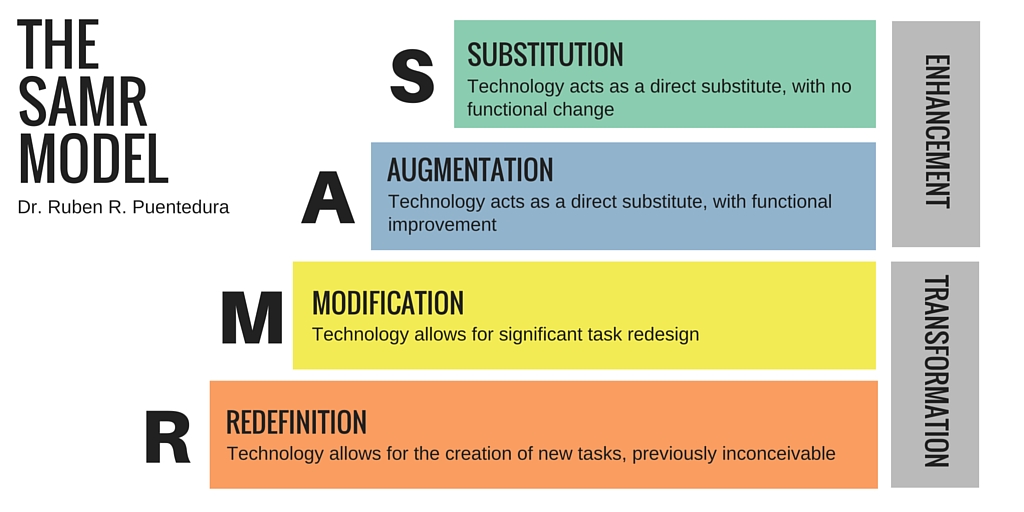
Finding My “Why”: The SAMR Model in Action

One of the most impactful moments in my tech journey came through the Red Mountain Writing Project’s Summer Institute in 2009. There, I began integrating tech tools like Edmodo long before “flipped classrooms” became mainstream. My practice grew again in 2013 when I encountered the SAMR Model at the Gulf Coast Conference on the Teaching of Writing. Developed by Dr. Ruben Puentedura, SAMR offers a framework for thinking about technology use not just as a substitute but as a transformationative tool for creating learning experiences that result in real-world synthesis.

What This Looks Like in Practice

In my classroom, redefinition takes the form of Padlet discussion boards, podcasts, digital portfolios, and student blogs. The world becomes their audience. As Lawrence (2022) writes, “Digital spaces are public spaces, and writing in these spaces shapes identity, culture, and power” (p. 12). As an NCTE Digital Democratic DIalouge (3D) Project teaching fellow, I led students through multimodal writing experiences—digital storytelling, podcast series, and social justice blogs—that connected their experiences to global issues. I wrote alongside them, rediscovering the “middle school journalist” in myself. 

The Digital Future Is Now

Digital writing made space for all of us to show up with purpose and voice. Writing happens organically for me, but technology expands that space for my students. It moves them from passive consumers to active creators of knowledge. Technology isn’t going anywhere. If we want our students to thrive, we must model intentional tech use—and teach students to do the same. That means helping them build digital portfolios, understand digital footprints, and express themselves responsibly on social media. As I often say to my students: you’re not just writing a paper—you’re writing your world. As educators, we are not just preparing scholars to navigate the world—we are teaching them to think, communicate, and express themselves authentically and civically in person and online. We’ve all heard the complaint: “Kids these days don’t think.” But what if it’s not that they can’t think? What if they simply haven’t been taught to think critically in a world where information is just a swipe away? 

Today’s students are digital natives. Siri responds faster than teachers can. Google is often more trusted than textbooks. But speed is not the same as synthesis. Access does not equal understanding. Digital writing goes beyond simply typing words on a screen; it involves deliberately communicating with others within a connected, online environment (Lawrence, 2022, p. 5). That distinction changes everything. If we are to prepare students for their future, we must not only use technology but also teach through it, with intention and vision.


📖 References

Lawrence, D. (2022). Digital writing: A guide to writing for social media and the Web. Broadview Press.

Puentedura, R. R. (2009). SAMR: A model for technology integration. [Presentation]. Retrieved from https://www.schoology.com/blog/samr-model-practical-guide-edtech-integration

National Council of Teachers of English. (2024, May 21). Digital Democratic Dialogue in Action: An intimate look inside the 3D Project. https://ncte.org/blog/2024/05/digital-democratic-dialogue-in-action/