

As educators, we are not just preparing scholars to navigate the world—we are teaching them to think, communicate, and express themselves authentically and civically in person and online. We’ve all heard the complaint: “Kids these days don’t think.” But what if it’s not that they can’t think? What if they simply haven’t been taught to think critically in a world where information is just a swipe away?
Today’s students are digital natives. Siri responds faster than teachers can. Google is often more trusted than textbooks. But speed is not the same as synthesis. Access does not equal understanding. Digital writing goes beyond simply typing words on a screen; it involves deliberately communicating with others within a connected, online environment (Lawrence, 2022, p. 5). That distinction changes everything. If we are going to prepare students for their future, we must embrace technology, not just use it, but teach through it, with intention and vision.
Reframing the Narrative
It’s time we move past the notion that technology is the enemy. I use it every day: widgets, apps, collaborative boards, podcasts—you name it. But it always starts with why. Why this tool? Why now? Why does this matter for my students’ purpose, voice, or identity? Lawrence (2022) warns that when we rely on tools without intention, we don’t create digital literacy—we create digital noise. Instead of asking, “What can this app do?” let’s ask, “What can students do with this app to create, connect, and think more deeply?”
Finding My “Why”: The SAMR Model in Action
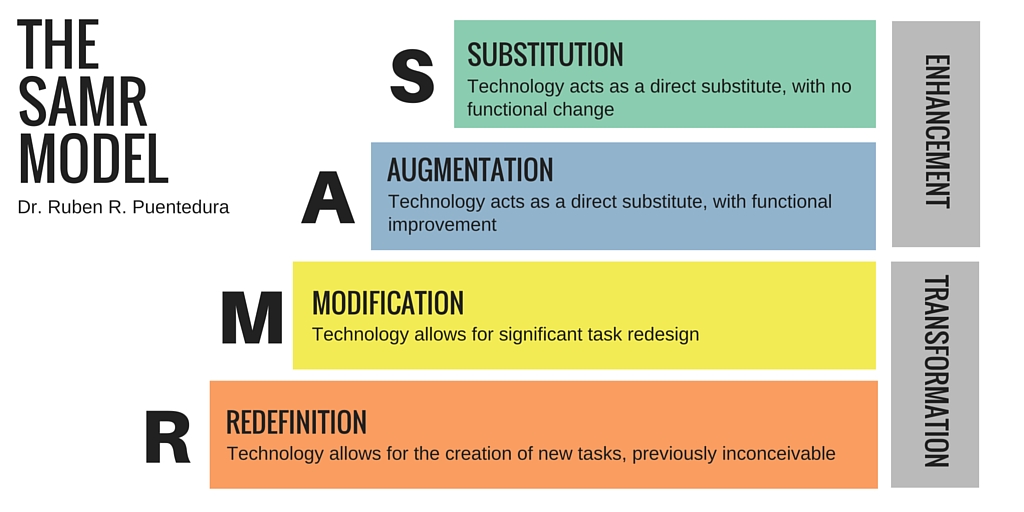
One of the most impactful moments in my tech journey came through the Red Mountain Writing Project’s Summer Institute in 2009. There, I began integrating tech tools like Edmodo long before “flipped classrooms” became mainstream. My practice grew again in 2013 when I encountered the SAMR Model at the Gulf Coast Conference on the Teaching of Writing. Developed by Dr. Ruben Puentedura, SAMR offers a framework for thinking about technology use not just as a substitute but as a transformationative tool for creating learning experiences that result in real-world synthesis.
What This Looks Like in Practice
In my classroom, redefinition takes the form of Padlet discussion boards, podcasts, digital portfolios, and student blogs. The world becomes their audience. As Lawrence (2022) writes, “Digital spaces are public spaces, and writing in these spaces shapes identity, culture, and power” (p. 12). As an NCTE Digital Democratic DIalouge (3D) Project teaching fellow, I led students through multimodal writing experiences—digital storytelling, podcast series, and social justice blogs—that connected their experiences to global issues. I wrote alongside them, rediscovering the “middle school journalist” in myself.
The Digital Future Is Now
Digital writing made space for all of us to show up with purpose and voice. Writing happens organically for me, but technology expands that space for my students. It moves them from passive consumers to active creators of knowledge. Technology isn’t going anywhere. If we want our students to thrive, we must model intentional tech use—and teach students to do the same. That means helping them build digital portfolios, understand digital footprints, and express themselves responsibly on social media. As I often say to my students: you’re not just writing a paper—you’re writing your world. As educators, we are not just preparing scholars to navigate the world—we are teaching them to think, communicate, and express themselves authentically and civically in person and online. We’ve all heard the complaint: “Kids these days don’t think.” But what if it’s not that they can’t think? What if they simply haven’t been taught to think critically in a world where information is just a swipe away?
Today’s students are digital natives. Siri responds faster than teachers can. Google is often more trusted than textbooks. But speed is not the same as synthesis. Access does not equal understanding. Digital writing goes beyond simply typing words on a screen; it involves deliberately communicating with others within a connected, online environment (Lawrence, 2022, p. 5). That distinction changes everything. If we are to prepare students for their future, we must not only use technology but also teach through it, with intention and vision.
📖 References
Lawrence, D. (2022). Digital writing: A guide to writing for social media and the Web. Broadview Press.
Puentedura, R. R. (2009). SAMR: A model for technology integration. [Presentation]. Retrieved from https://www.schoology.com/blog/samr-model-practical-guide-edtech-integration
National Council of Teachers of English. (2024, May 21). Digital Democratic Dialogue in Action: An intimate look inside the 3D Project. https://ncte.org/blog/2024/05/digital-democratic-dialogue-in-action/
I really enjoyed what you had to say about pushing against the “these kids” mentality. Like you, I believe we need to meet students where they are: online. If we as teachers fear technology and drive it out of the classroom completely, we will, in part, raise a generation of students who are not properly informed about how to be the best digital citizens they can be. Lawrence (2022) states, “The problems of social media are the problems of our daily lives, our children’s lives, and the world that we are building for future generations” (p. 2). It is vital that we teach students how to use social media and other digital tools to better understand the world, but I would argue that it is equally important to teach them how to unplug. Hietajärvi et al. (2022) inferred through in depth research that “Students who experience symptoms of school burnout may increase their social media or gaming engagement as an escape; this may evolve into an excessive habit with consequences for general psychological wellbeing” (p. 28). Above all, it is our responsibility as educators to ensure that we are setting our students up for success both online and off.
ReplyDeleteReferences:
Hietajärvi, L., Maksniemi, E., Lonka, K., Hakkarainen, K., Alho, K., & Salmela-Aro, K. (2022). Digital engagement, school burnout and academic performance: Longitudinal within-student relations. Open Science Framework Preprints.
Lawrence, D. (2022). Digital writing: A guide to writing for social media and the web. Broadview Press.
I really appreciate your perspective on being intentional and modeling appropriate technology use in the classroom. As a school counselor, I see how important it is not just to set limits on technology, but to actively guide students in using it with purpose. The American School Counselor Association (ASCA, 2023) emphasizes helping students develop digital citizenship skills, including responsible decision-making and ethical tech use.
ReplyDeleteWhen the adults at school model intentional technology use—whether that’s through digital writing, research, or mindful social media habits—we’re equipping students with skills they’ll need long after middle school. Lawrence (2022) emphasizes using technology and tools for good and to express meaning effectively and accomplish communication goals. It’s not about avoiding technology; it’s about shaping how students engage with it thoughtfully and confidently.
References:
American School Counselor Association. (2023). The school counselor and student safety: Digital. ASCA.
Lawrence, D. (2022). Digital writing: A guide to writing for social media and the web. Broadview Press.